
#07 The 10 Physics Mistakes That Are Costing Your Child Marks — Straight From the Examiner's Table
CBSE Class 12 Physics isn't just about knowing the subject. It's about knowing what the examiner is looking for — and most students don't.

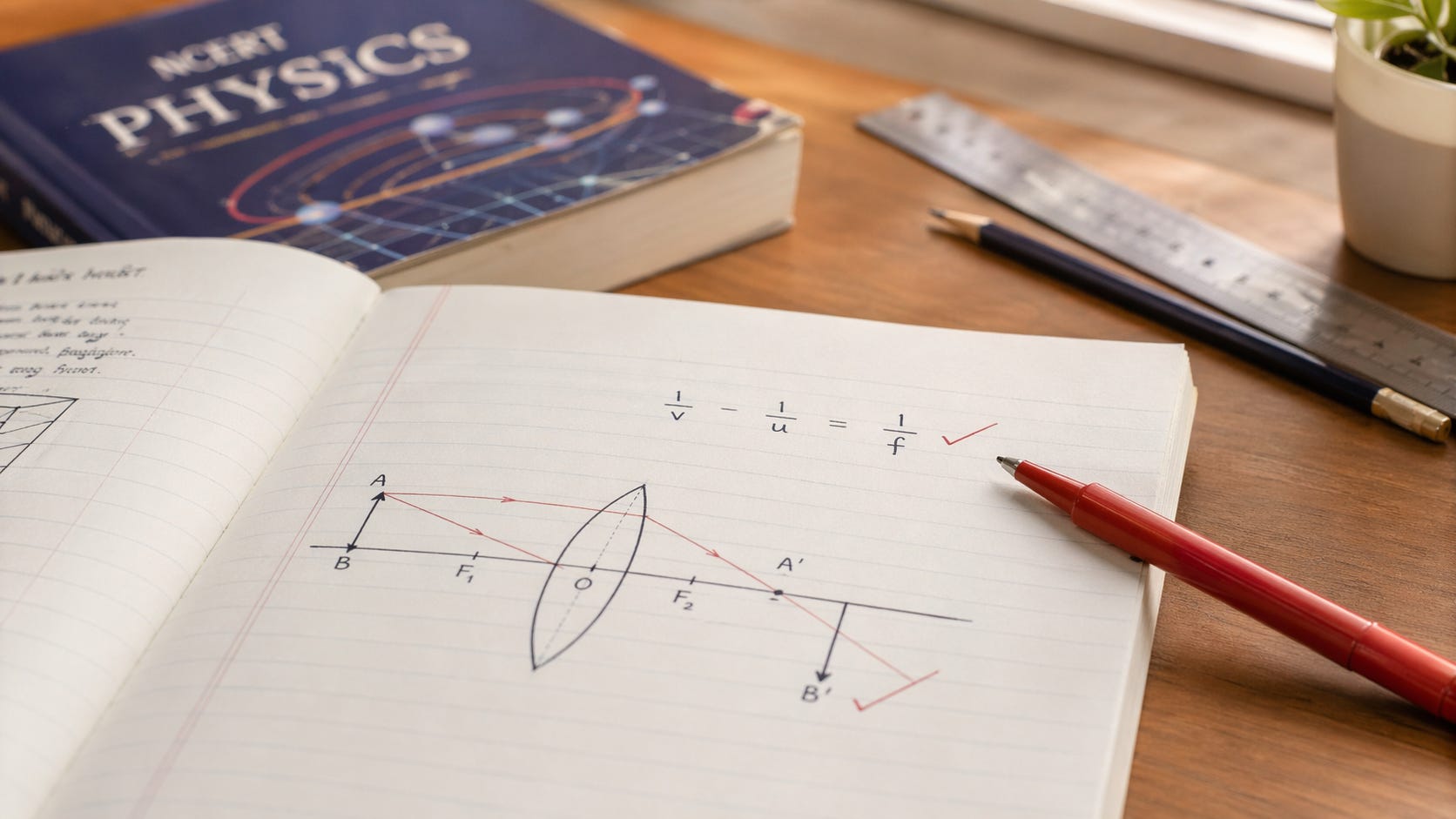
Every year, lakhs of Class 12 students walk out of the Physics paper convinced they’ve done well — and then stare at a score that doesn’t match that feeling. The tragedy? Most of those lost marks had nothing to do with intelligence. They had everything to do with avoidable errors that experienced CBSE examiners see repeated, year after year, across thousands of answer sheets.
I’ve been teaching Physics for Class 12 CBSE and TN State Board students for years, and what I’m sharing here is grounded in published examiner guidance, official CBSE marking schemes, and the very real patterns I see in how marks vanish even from prepared students.
Read this slowly. And more importantly, practice these till it becomes your nature.
Mistake #1 — The Formula Was Right. But It Wasn’t Written.
This is the single most heartbreaking way to lose marks. A student solves the numerical correctly, gets the right answer, and still loses 1 mark — sometimes more — because they didn’t write the formula before substituting values.
Here’s what examiners know that students don’t: in CBSE’s step-marking system, the formula itself carries independent marks. That means your derivation, substitution, calculation, and unit are each evaluated separately. Skipping the formula step is handing the examiner a reason to dock you — even if your final answer is perfect.
The fix: Before every numerical, write the formula. Every single time. No exceptions.
Mistake #2 — Flipping the Numerator and Denominator
This one wipes out the entire numerical in a single stroke. Students often know the formula concept but mix up which quantity goes on top. The classic example:
For parallel resistors, the correct formula is 1/R = 1/R₁ + 1/R₂
But under exam pressure, students frequently write R = 1/R₁ + 1/R₂
Similarly, for capacitors in series: 1/C = 1/C₁ + 1/C₂ gets written as C = 1/C₁ + 1/C₂
When the starting formula is wrong, no step marks are awarded for what follows. The entire working is rendered null. Examiners cannot give benefit of the doubt here.
The fix: Drill these “reciprocal formulas” as a separate revision category. Write them out 10 times the week before the exam.
Mistake #3 — The Diagram Is There, But Nothing Is Labelled
Ray diagrams in Optics. Circuit diagrams in Electricity. Diagrams of a cyclotron, a transformer, a moving coil galvanometer. These carry marks in two ways — for the diagram itself, and for the labelling.
Students who draw diagrams under time pressure often skip labels, thinking the drawing itself communicates everything. It doesn’t — not to an examiner scanning hundreds of sheets. An unlabelled diagram is an incomplete answer. Marks are specifically allocated for labels including focal length, object distance, image position, principal axis, and the nature of the image.
Per published CBSE examiner guidance, students should draw all diagrams in pencil. Labels can be in pen or pencil. The key is clarity and completeness.
The fix: Practice every major diagram with labels as part of the diagram itself, not as an afterthought.
Mistake #4 — Sign Convention Errors in Ray Optics
Sign convention is the single most consistent source of mark loss in the Ray Optics chapter — and it’s almost entirely avoidable. Students who memorise signs mechanically tend to get them wrong under pressure. Students who understand the logic behind them almost never do.
The Cartesian sign convention states that distances measured in the direction of incident light are positive, and those measured against it are negative. That one rule governs everything — mirrors, lenses, refraction at surfaces. When students apply signs without this physical understanding, they substitute wrong values and the numerical collapses.
An experienced examiner writing for India Today in 2026 made this point explicitly: associating signs with direction, rather than memorising them as abstract rules, significantly reduces errors in Ray Optics numericals.
The fix: Before substituting any value in a mirror or lens formula, write u, v, f with their signs and the reason. Make it a habit, not a step you do when you have time.
Mistake #5 — Missing Units or Writing the Wrong Ones
No unit, no full marks. This is non-negotiable in CBSE Physics. Examiners are required to deduct marks when the unit is absent from a numerical answer, and they do.
What makes this worse is that students also write incorrect units — writing Newton when the answer is in Joules, or Volt when it should be V/m. This happens most often in chapters like Electrostatics, Electromagnetic Induction, and Modern Physics, where units are not always intuitive.
The fix: At the end of every numerical, before moving on, check three things: the formula, the substituted values, and the unit of the final answer. Make this a non-negotiable three-second checkpoint.
Mistake #6 — Answering 1-Mark “Yes/No” Questions With Just Yes or No
This surprises most students when I tell them. A question that asks “Is Ohm’s law applicable to semiconductors? Justify your answer.” is a 1-mark question — but that 1 mark is split into two half-marks: one for the answer, one for the reason.
Students who write just “No” get half a mark. Students who write “No, because Ohm’s law requires a linear relationship between voltage and current, which semiconductors do not exhibit” get full marks.
This pattern appears frequently in 1-mark and 2-mark assertion-reasoning type questions across the paper.
The fix: For any yes/no or true/false question, train yourself to always follow the answer with a one-sentence justification. Always.
Mistake #7 — Skipping Sub-Parts of Multi-Part Questions
This is a mark-loss pattern that examiners see constantly. A question of 5 marks might have four sub-parts — (a), (b), (c), (d) — and students, rushing or distracted, skip (c) entirely. That could mean losing 1 to 1.5 marks on a question they otherwise answered well.
This happens especially when sub-parts are phrased as “Also find...” or “Hence show that...” — language students often read past when they’re focused on the main calculation.
The fix: Read the full question — every word, every sub-part — before writing a single line of the answer. Underline or circle sub-part markers as you read.
Mistake #8 — Answer Length That Doesn’t Match the Marks Allotted
A 1-mark question answered in half a page does two things: it wastes your time, and it signals to the examiner that you don’t understand what the question is asking. A 5-mark question answered in three lines suggests the same.
CBSE examiners are trained to look for key points, not volume. For a 2-mark “value-based” or application-based question, 3 to 4 focused sentences are expected. For a 1-mark definition, one sentence is enough. Writing more than required does not earn extra marks in CBSE.
The fix: Before answering, look at the marks. Use that number as your guide. 1 mark = 1 key idea. 2 marks = 2 key ideas. 5 marks = 5 to 6 well-explained points.
Mistake #9 — Rewriting an Answer Without Striking Out the First Attempt
This is a CBSE rule that most students and many parents don’t know. If a student reattempts a question and does not strike out the first answer, the examiner is instructed to evaluate the first attempt and ignore the second — regardless of which is correct.
Students who realise they’ve made an error, rework the problem correctly, but forget to strike through the wrong version end up being marked on their mistake.
The fix: Any time you rewrite an answer, draw a clear single line through the incorrect version immediately. Don’t leave it for later.
Mistake #10 — Derivations With Missing Steps
CBSE Physics derivations — whether it’s the derivation of the mirror formula, lens maker’s equation, or expression for magnetic field using Ampere’s law — are evaluated step by step. The final result alone does not carry full marks.
Examiners award marks at specific logical steps in the derivation: the initial setup, the application of the relevant law or principle, the intermediate mathematical manipulation, and the final expression. If a student jumps from the first line to the last, they lose all the intermediate step marks even if the result is correct.
This is especially important in 3-mark and 5-mark derivation questions, where 2 or more marks are typically distributed across the working steps.
The fix: Practice derivations by writing every step explicitly, exactly as it appears in NCERT. Don’t condense. The examiner’s marking scheme maps to NCERT’s structure.
One Last Thing For Parents Reading This
These are not about being weak in Physics. Some of India’s brightest science students lose 10 to 15 marks on their Physics board paper because of exactly these patterns. The subject knowledge is there. The exam awareness is not.
The good news: every single mistake on this list is fixable before the exam. None of them require re-learning a chapter. They require awareness, practice under exam conditions, and someone who points them out before it’s too late — not after.
Found this useful? Subscribe below and get every new article on board exam strategy delivered straight to your inbox. Free, always. No spam, ever.
Prof. Dr. S. Balaji teaches Physics and Chemistry for Class 12 CBSE and TN State Board students in Kanchipuram and online. This article is part of the Board Exam Insider series. 📞 +91 97876 92116 · profbalaji.carrd.co